It boggles my mind that I haven't written in more than a month. Where has the time gone? It's not that I haven't been busy, or that I haven't been working. I have. I've just ignored some of my networking responsibilities in order to take care of other things. It's time to get back to work here.
I have committed the next year to focusing on building a consistent body of work. In other words, I'm going to attempt to actually focus on one theme throughout the year. The Studio Art Quilters Association will begin "The Visioning Project" this fall. I have committed to this one goal and the group of artists who are also taking part, will, hopefully, be able to hold me accountable for getting the work done.
This means I will need to create balance between my daily life and my art studio, as well as create a balance in working on my art. I am interested in so many different things, there are times I feel scattered and unfocused as I work - jumping from one technique to another, from one project to another.
It's going to be interesting to see what happens as I actually attempt to focus myself and work intentionally in a different manner than I'm used to. I will be blogging on my experiences as I work. Because a year long focus is new for me, as well as the type of work I'm contemplating, I have no idea what will happen other than, I know I will learn much about myself.
Vacation's over - time to get to work and create my balancing act.
Showing posts with label fiber art. Show all posts
Showing posts with label fiber art. Show all posts
Thursday, August 20, 2009


Friday, May 22, 2009
Does Art Always Need a Title?
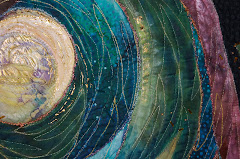
 I've been thinking about titles and art work, and wondering if it's necessary to title everything. I know there are many untitled works hanging in galleries world wide, but the majority of my work is titled, and today, I'm wondering why I find it necessary. The meaning of every work of art is decided by the viewer. I suppose if the artist wants to lead the viewer, a title might be helpful, but I wonder if even then, a title really makes a difference.
 This is a piece I just completed, with full view and detailed. It's hand-dyed cotton with thread, paint, iridescent gel medium, and dyed cheese cloth. I have not titled it. I'm wondering what others see in it, what thoughts and/or emotions are evoked in the viewer. I look forward to comments, and think I'll leave it untitled. At least for now.
Wednesday, April 22, 2009
After the Rush

After delivering the vestments on April 10th, I spent a week focusing intensely on the final preparations for my daughter's wedding, which was Saturday, April 18. It was a beautiful wedding, made more beautiful by the sheer joy reflected in both faces of this young couple. They've waited seven years to make it "official". I am thrilled for them.
It is a strange feeling as I write this, however. With my large project mostly finished and delivered, and my daughter's wedding over, I have time to reflect. Both of my children are young women. Both are married and I am the grandmother of a four-year-old granddaughter. I am content in my life, my relationships, and am pursuing the artist' life I've always dreamed of having. So where has the time gone?! I swear I've been aware of every part of my life as I've lived it, yet looking back, it seems as if it's gone so quickly. Weren't they just little girls yesterday? Wasn't it only a week ago that I was taking pictures of their first steps, first day of school, first date? There's art in the making here. Time . . . an intangible that there's never enough of.
Friday, April 10, 2009
The Satisfaction of Completion
 I have finished the major portion of the commission I have been working on. The chasuble is the piece I had the mishap with the lining!! Thank goodness for reputable fabric stores who keep good fabrics in stock and will send things quickly.
There are two pieces remaining to be completed, and I will finish them in the next week. These pieces and three others were delivered yesterday. They will be used this weekend for the Easter services, beginning Saturday night.
 Each time I accept a commission, I wonder if I've lost my sanity while I'm working on it. The deadlines do help me buckle down and get things finished, but when I mess up, it creates more anxiety than I like. And yet, when the piece is completed, and I see that the "client" likes it, I am ecstatic! It's all worth it, and I will continue to accept commissions. I find them challenging and great learning experiences.
I wonder about other artists and commission work. Even though it can be anxiety producing to accept them, the reward is so great when I see their face as the work is unveiled. I'd be interested to hear what other artists think or feel about accepting commissions.

Friday, April 3, 2009
Breathing Deeply
I know that in the world of creative endeavors, there is a great possibility that what I've created or attempted to create from the vision in my head, won't work, and I'll need to start over. Many projects have ended up in the waste basket, but I have learned from the mistakes. That's why I try to give myself extra time to work on things when there is a deadline involved. Even so, I've lived the past few years with the horrible fantasy of mis-cutting something right before a deadline, and having to order fabric to finish the commission. I just kept telling myself that if I were very careful, it wouldn't happen.
Well, it's happened! I miscalculated, my pattern slipped, and I don't have enough fabric to re-cut the pieces. I have one week to deliver this work. I have ordered more fabric and am hoping upon hope it arrives within 2 days. It was either that or pay as much as the fabric is worth to have it sent over night. I'm just thankful it isn't the night before, and also thankful that it's the lining rather than the top, which is where all the fancy stuff has been completed. I'm trying to look at the bright side. I'm also trying not to panick. That wouldn't be helpful.
So, I'll focus my energy on the companion pieces until the new fabric arrives, and breathe deeply, in and out.
Well, it's happened! I miscalculated, my pattern slipped, and I don't have enough fabric to re-cut the pieces. I have one week to deliver this work. I have ordered more fabric and am hoping upon hope it arrives within 2 days. It was either that or pay as much as the fabric is worth to have it sent over night. I'm just thankful it isn't the night before, and also thankful that it's the lining rather than the top, which is where all the fancy stuff has been completed. I'm trying to look at the bright side. I'm also trying not to panick. That wouldn't be helpful.
So, I'll focus my energy on the companion pieces until the new fabric arrives, and breathe deeply, in and out.
Saturday, March 7, 2009
Why is it Difficult to Claim the title of Artist?
As I've been reading blogs and tweets and articles, and talking with other artist friends, I have noticed that it's difficult for some creative people to refer to themselves as artists. There's a tendency to apologize for being creative, and spending time in creative endeavors. This strikes a chord with me, because I, too, still fight feelings of inadequacy and insecurity.
I remember having a conversation quite a few years ago with another artist friend, about whether we were artists with a capital "A" or a lower case "a". I'll give us credit for the fact that we were even talking about being artists, as I felt that just referring to myself that way was somehow unthinkable. Years later, it seems somewhat sad that we even contemplated a difference. Which brings me to the question, what is the mystique of calling oneself an artist? Why is it so difficult to claim the title?
David Bayles and Ted Orland, in their book "Art and Fear" talk about the "view of artmaking today - namely, that art rests fundamentally upon talent, and that talent is a gift randomly built into some people and not into others." In other words, the artist has been given a gift and is able to create great works of art because of this alone. Prodigies are rare, but as a culture we've all bought into the image. Speaking for myself, it leaves me with feelings of insecurity, and wondering if I'm "talented" enough.
Intellectually, I know, art is made by ordinary people. People who work hard to learn the basics; who produce a lot of work that ends up in the waste basket. While talent might be a step in the proverbial direction, it's really an issue of passion. When the desire to create overcomes the fear of not being perfect, one can make marks on the paper, or put brush to canvas or cut the fabric. When I'm not thinking about the end result, but focusing on the process, I learn something. What I'm producing in that moment may not be the best work of art I've ever done, but the knowledge gained from creating it will be put to use on the next piece. It's the passion that makes me want to go the next step, create the next piece. It may end up as part of the trash tomorrow, but today, it's what I do.
So, what about others? Is it difficult for you to call yourself an artist? And if not, have you always been able to? I welcome your comments.
I remember having a conversation quite a few years ago with another artist friend, about whether we were artists with a capital "A" or a lower case "a". I'll give us credit for the fact that we were even talking about being artists, as I felt that just referring to myself that way was somehow unthinkable. Years later, it seems somewhat sad that we even contemplated a difference. Which brings me to the question, what is the mystique of calling oneself an artist? Why is it so difficult to claim the title?
David Bayles and Ted Orland, in their book "Art and Fear" talk about the "view of artmaking today - namely, that art rests fundamentally upon talent, and that talent is a gift randomly built into some people and not into others." In other words, the artist has been given a gift and is able to create great works of art because of this alone. Prodigies are rare, but as a culture we've all bought into the image. Speaking for myself, it leaves me with feelings of insecurity, and wondering if I'm "talented" enough.
Intellectually, I know, art is made by ordinary people. People who work hard to learn the basics; who produce a lot of work that ends up in the waste basket. While talent might be a step in the proverbial direction, it's really an issue of passion. When the desire to create overcomes the fear of not being perfect, one can make marks on the paper, or put brush to canvas or cut the fabric. When I'm not thinking about the end result, but focusing on the process, I learn something. What I'm producing in that moment may not be the best work of art I've ever done, but the knowledge gained from creating it will be put to use on the next piece. It's the passion that makes me want to go the next step, create the next piece. It may end up as part of the trash tomorrow, but today, it's what I do.
So, what about others? Is it difficult for you to call yourself an artist? And if not, have you always been able to? I welcome your comments.
Wednesday, March 4, 2009
How Do We Balance Social Networking and the Business of Work?
I've just entered the social networking system with Facebook, Twitter and LinkedIn. Information moves almost instantaneously. I can "instant message" with any one of my "friends" who happen to be online through Facebook, or through my computer's camera on other networks with family and friends anywhere in the world. I can find and network with those who might have mutual business interests and I don't even need to leave my house. The world at my fingertips!
While all of this is wonderful, and somewhat miraculous to my baby boomer mind, I also feel a little bit like my "network" is beginning to sweep me off my feet and carry me down stream. I'm having difficulty keeping up and wondering when some people who post often to Twitter, etc. get their work done. Finding people around the world to network with is great and offers unlimited possibilities to build a business, but how do others balance the actual work production of art for sale (which is why one networks, isn't it?) with marketing and connecting?
I'd certainly be open to suggestions as I'm finding it a difficult balance. How about it . . . how do YOU find the balance?
While all of this is wonderful, and somewhat miraculous to my baby boomer mind, I also feel a little bit like my "network" is beginning to sweep me off my feet and carry me down stream. I'm having difficulty keeping up and wondering when some people who post often to Twitter, etc. get their work done. Finding people around the world to network with is great and offers unlimited possibilities to build a business, but how do others balance the actual work production of art for sale (which is why one networks, isn't it?) with marketing and connecting?
I'd certainly be open to suggestions as I'm finding it a difficult balance. How about it . . . how do YOU find the balance?
Wednesday, February 25, 2009
What's an art quilt?
I was asked by a fellow artist the other day, why so many different names for art made from fiber, i.e. art quilt, fiber art, textile art, mixed media, etc. She also made a statement that as she has perused other artists blogs and websites, what she often sees that is referred to as quilt art, has nothing to do with quilts. She was somewhat confused. I attempted to explain how I see the differences and why different people might want to refer to what they do differently. That attempt follows:
What is an art quilt? According to several organizations, the definition of a quilt is, 2 or more layers held together by stitching. Most will have a fabric sleeve on the back for hanging with a rod. An art quilt is intended for the wall, and may or may not have, any number of surface design treatments, using applique' and/or other media, such as paint, ink, photo transfer, beads, yarns, and found objects attached in one way or another to create the image.
Most quilt shows now have a category for art quilts. As a matter of fact the International Quilt Association show in Houston every year is really dedicated to the art quilt as well as "the art of quilting", offering thousands of dollars in awards for the most outstanding work. The American Quilters Society is another large association that has large shows offering awards, and has a quilt museum in Paducah, KY.
Contemporary quilting is very different from the quilts our foremothers made. The majority are no longer only utilitarian pieces made from clothing scraps. The patterns are well thought out, drafted and executed using a sense of color and design to enhance the pattern. The quilting, or stitching, patterns themselves have evolved into being more and more complex. The majority of quilts are quilted by machine rather than hand. Even if a quilt is intended for the bed, coordinating and contrasting colors and fabrics forming the design, present a contemporary way of creating quilts.
I believe there is a bit of politics involved as well when referring to ones art as art quilt, fiber/textile or mixed media art. In my experience, as soon as someone hears the word "quilt", grandma's bed quilt/blanket tend to be the associations. For some, to call themselves fiber or textile artists, or mixed media artists, gets away from that perception, and they feel their work won't be prejudged by the term quilt. These artists may want to become involved in gallery shows as well as, or instead of, quilt shows.
Not all fiber art meets the definition of a quilt. Some artists frame their work, or put it on stretchers to hang. In these cases, the work may not consist of layers held together by stitch, but instead may be any treatment of fabric or use of fibers in a surface design. My own work consists of both art forms, the art quilt, and fiber art that is intended to be framed or stretched as a canvas. Therefore, I refer to myself as a mixed media and/or fiber or textile artist.
For more information on textile art go to: Studio Art Quilters Assocation and/or the Surface Design Association
What is an art quilt? According to several organizations, the definition of a quilt is, 2 or more layers held together by stitching. Most will have a fabric sleeve on the back for hanging with a rod. An art quilt is intended for the wall, and may or may not have, any number of surface design treatments, using applique' and/or other media, such as paint, ink, photo transfer, beads, yarns, and found objects attached in one way or another to create the image.
Most quilt shows now have a category for art quilts. As a matter of fact the International Quilt Association show in Houston every year is really dedicated to the art quilt as well as "the art of quilting", offering thousands of dollars in awards for the most outstanding work. The American Quilters Society is another large association that has large shows offering awards, and has a quilt museum in Paducah, KY.
Contemporary quilting is very different from the quilts our foremothers made. The majority are no longer only utilitarian pieces made from clothing scraps. The patterns are well thought out, drafted and executed using a sense of color and design to enhance the pattern. The quilting, or stitching, patterns themselves have evolved into being more and more complex. The majority of quilts are quilted by machine rather than hand. Even if a quilt is intended for the bed, coordinating and contrasting colors and fabrics forming the design, present a contemporary way of creating quilts.
I believe there is a bit of politics involved as well when referring to ones art as art quilt, fiber/textile or mixed media art. In my experience, as soon as someone hears the word "quilt", grandma's bed quilt/blanket tend to be the associations. For some, to call themselves fiber or textile artists, or mixed media artists, gets away from that perception, and they feel their work won't be prejudged by the term quilt. These artists may want to become involved in gallery shows as well as, or instead of, quilt shows.
Not all fiber art meets the definition of a quilt. Some artists frame their work, or put it on stretchers to hang. In these cases, the work may not consist of layers held together by stitch, but instead may be any treatment of fabric or use of fibers in a surface design. My own work consists of both art forms, the art quilt, and fiber art that is intended to be framed or stretched as a canvas. Therefore, I refer to myself as a mixed media and/or fiber or textile artist.
For more information on textile art go to: Studio Art Quilters Assocation and/or the Surface Design Association
Subscribe to:
Posts (Atom)

 Posts
Posts


